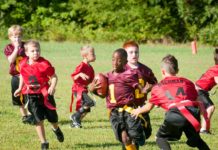
Video credit: Flag Football with Coach D / YouTube — “Youth Flag Football Conditioning Workout for Kids.”
The flag football season may be over, but that doesn’t mean young athletes need to put the football away until the next kickoff.
In fact, the off-season can be one of the best times for a young player to improve movement skills, general fitness and confidence without turning every afternoon into another exhausting practice.
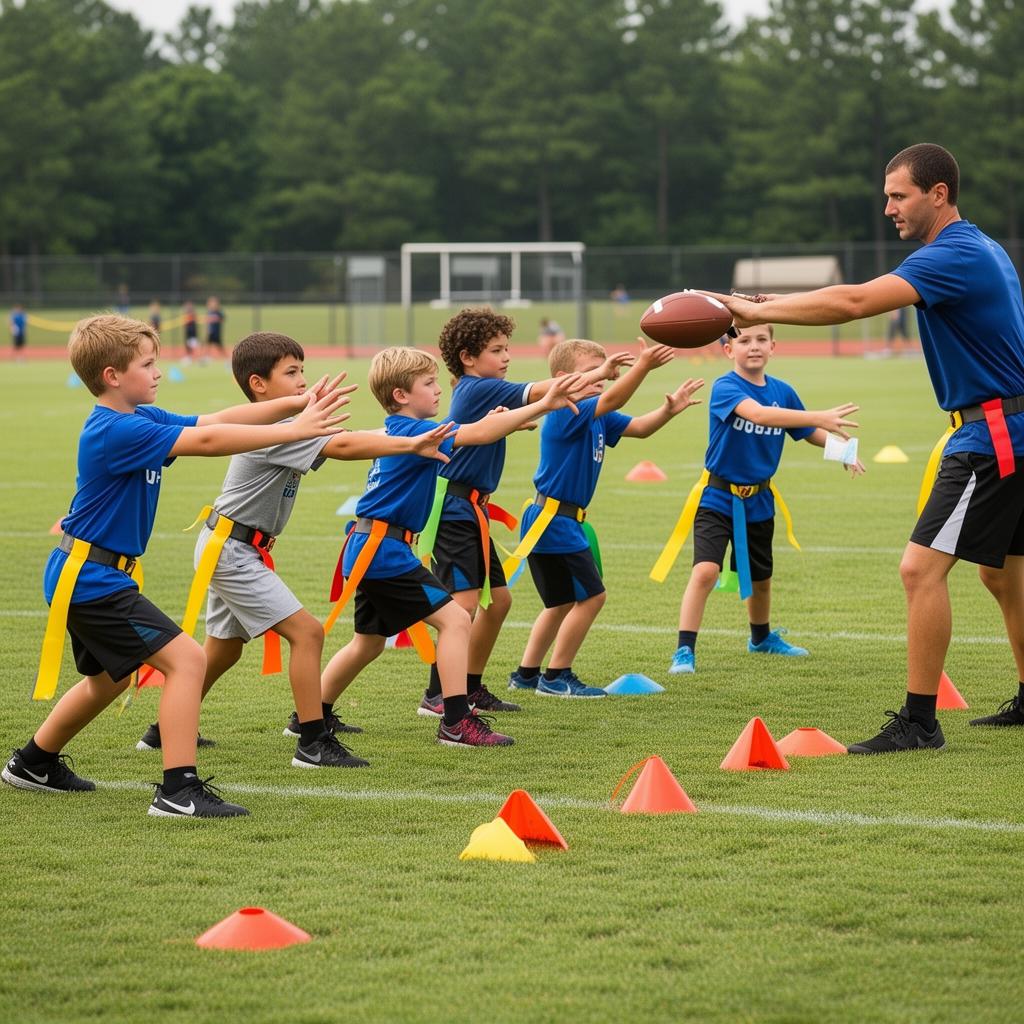
The trick is knowing what kind of conditioning actually helps kids.
For youth flag football, conditioning shouldn’t be about turning an eight-year-old into a miniature bodybuilder. It should be about teaching better movement, improving general strength, developing speed and agility, and keeping activity fun enough that the child actually wants to do it again tomorrow.
The American Academy of Pediatrics supports appropriately designed resistance training for children and adolescents when technique, progression and qualified supervision are emphasized. The CDC also recommends that children and teens ages 6–17 get at least 60 minutes of physical activity each day, including muscle- and bone-strengthening activity at least three days per week.
That’s a much better starting point than simply shouting, “DROP AND GIVE ME TWENTY!”
Why Off-Season Conditioning Matters for Youth Flag Football
Flag football looks simple until you watch a good player closely.
They’re constantly accelerating, stopping, changing direction, backpedaling, tracking the ball, catching, throwing and reacting to other players.
A player doesn’t need to be huge to do those things well.
They need to be quick, coordinated, balanced and confident.
That’s why a smart youth flag football conditioning program works on more than just running.
It develops a broad athletic foundation that can help with football and other sports too.
Youth Flag Football HQ’s own drill resources emphasize keeping practices moving and fun while progressively developing basic movement, catching, running, route and flag-pulling skills.
Start with the site’s Youth Flag Football Drills collection for additional practice ideas.
Is Strength Training Safe for Kids?

This is probably the first question parents ask.
And understandably so.
The good news is that modern pediatric guidance does not treat all youth resistance training as dangerous. The American Academy of Pediatrics says resistance training can be safe and effective for children and adolescents when exercises are age-appropriate, technique is taught properly and supervision is appropriate.
The key is how the training is done.
For young flag football players, that often means beginning with movements using body weight, light resistance, medicine balls, resistance bands or other simple tools rather than chasing maximum loads.
The AAP specifically recommends learning movement patterns with little or no load before gradually adding resistance, and it advises against maximal lifting approaches for children who are not physically mature.
Read the American Academy of Pediatrics guidance on youth resistance training
For younger children or athletes with medical conditions, prior injuries or other concerns, parents should discuss training with an appropriate healthcare professional before starting a formal strength program.
What Does Strength Training Look Like for a Young Flag Football Player?
Forget the image of a kid standing under a giant barbell.
Youth strength training can be much simpler.
Think:
- Bodyweight squats
- Push-ups
- Planks
- Lunges
- Step-ups
- Light resistance-band exercises
- Medicine-ball throws
- Controlled jumping and landing
- Balance exercises
The goal is not to make the child exhausted.
The goal is to help them learn how to control their body.
That foundation becomes useful when a player has to plant one foot, change direction and accelerate after a flag.
1. Start With Movement Skills Before Heavy Resistance
This is one of the biggest lessons parents and coaches can take from modern youth training guidance.
Movement quality comes first.
Before adding resistance, make sure the child can squat, hinge, lunge, jump and land with reasonable control.
Imagine teaching someone to drive a car.
You wouldn’t hand them a race car before they’ve learned where the brakes are.
The same idea applies here.
Master the movement first. Make it more challenging later.
For coaches, the basic flag football skills guide is useful for reinforcing foundational football movements alongside physical conditioning.
2. Build Lower-Body Strength for Faster Cuts

Flag football players spend a lot of time using their legs.
They sprint.
They stop.
They cut.
They accelerate again.
That makes lower-body strength a useful part of off-season conditioning.
Simple Exercises to Try
- Bodyweight squats
- Reverse lunges
- Step-ups
- Glute bridges
- Single-leg balance
Keep the movements controlled. There is no award for completing 100 sloppy squats while looking like a malfunctioning robot.
Quality beats quantity.
Our advanced youth flag football drills can then help connect movement ability with football-specific skills.
3. Add Short Sprint Work for Speed
Young flag football players don’t need endless long-distance running to get fitter.
Flag football is filled with short bursts.
So practice short bursts.
Try 5- to 15-yard accelerations with plenty of recovery between efforts.
For example:
- Start from a standing position.
- Sprint 5 yards.
- Walk back.
- Rest briefly.
- Repeat with a different starting position.
You can make this much more fun by calling it a “race to the cone” rather than a conditioning drill.
Kids have an amazing ability to work harder when they believe they’re playing a game.
4. Teach Agility Instead of Just Running in a Straight Line
Speed is useful.
But in flag football, the ability to change direction quickly can be even more important.
Use cones, lines or an agility ladder to create simple movement patterns.
Try These Patterns
- Two-foot ladder steps
- Side shuffles
- Forward-backward movements
- Five-yard shuttle runs
- Cone zigzags
- Reaction starts
Don’t make every agility drill perfectly predictable.
Occasionally point left or right and make the athlete react.
That’s much closer to what happens in an actual game.
You can also use ideas from Youth Flag Football HQ’s advanced skills and agility drills.
5. Strengthen the Core for Better Body Control
“Core training” doesn’t have to mean an endless collection of sit-ups.
A strong core helps young athletes control their trunk while running, changing direction and throwing.
Simple Youth-Friendly Core Exercises
- Front plank
- Side plank
- Bird dog
- Dead bug
- Glute bridge
Keep the focus on control.
If the child is shaking like a washing machine on spin cycle, it’s probably time to stop or make the exercise easier.
For more information about youth positions and how different movement demands fit different roles, see the flag football positions guide.
6. Add Jumping, Hopping and Landing Skills
Plyometric movements can be useful in youth athletic development when they are taught appropriately and performed with good technique.
For young players, simple exercises can include:
- Two-foot jumps
- Small forward hops
- Side-to-side hops
- Low step-off landings
- Jump-and-stick exercises
The landing is the important part.
Teach the child to land under control instead of simply jumping as high as possible.
Soft knees. Balanced position. Controlled movement.
It isn’t about making the biggest jump on the field.
It’s about learning how to handle your body when it comes back down.
7. Use Medicine Balls for Power and Fun
Medicine balls can be a fantastic way to make strength training feel more like sport practice.
Depending on the child’s age and experience, coaches can use very light medicine balls for simple throwing and catching exercises.
Fun Ideas
- Chest passes
- Overhead throws
- Rotational throws
- Target throws
- Partner tosses
Keep the ball light enough that the athlete can maintain good control.
The goal isn’t to see how far a child can launch a medicine ball across the parking lot.
That is how coaches accidentally create a new sport called “Where Did the Ball Go?”
8. Don’t Forget Aerobic Conditioning
Strength training is only one piece of off-season development.
The older article correctly emphasized that a complete conditioning program should also include aerobic activity, flexibility and healthy nutrition.
Current CDC guidance recommends that children ages 6–17 accumulate at least 60 minutes of moderate-to-vigorous physical activity each day, with vigorous activity, muscle-strengthening and bone-strengthening activity included on at least three days each week.
See the CDC physical activity guidelines for children and adolescents
The good news is that aerobic activity doesn’t have to mean jogging around a track.
It can include:
- Biking
- Swimming
- Playing tag
- Hiking
- Running games
- Other sports
Variety is your friend.
9. Turn Conditioning Into Flag Football Games
This may be the most important tip of all.
Kids like games.
They generally don’t get especially excited when somebody announces a 45-minute conditioning lecture followed by another 45-minute conditioning lecture.
Youth Flag Football HQ recommends using games that combine conditioning with football skill development, which is a great approach for the off-season.
Try:
Sharks and Minnows
One defender becomes the shark while the other players try to cross the playing area without losing a flag.
It’s fun, competitive and naturally includes sprinting, dodging and flag-pulling.
More ideas can be found in the flag football games for kids collection.
Cone Chase
Place several cones in a small area. Call out a color or number and have players race to it.
This adds a simple reaction component to conditioning.
Mirror Drill
One player leads while another mirrors their movements inside a small box.
This can build agility and reaction skills without making the exercise feel like formal conditioning.
A Simple 30-Minute Youth Flag Football Off-Season Workout
Parents and coaches don’t need a complicated spreadsheet.
A simple session might look like this:
| Time | Activity |
|---|---|
| 5 minutes | Easy movement and dynamic warm-up |
| 5 minutes | Bodyweight strength exercises |
| 5 minutes | Short acceleration drills |
| 5 minutes | Agility and reaction work |
| 5 minutes | Flag football skill drill |
| 5 minutes | Fun conditioning game and easy cool-down |
The exact amount should be adjusted for the child’s age, experience, fitness level and total activity outside the session.
How Often Should Kids Do Strength Training?
The answer isn’t “every day.”
For youth resistance training, AAP guidance supports sensible programming with appropriate recovery, technique and supervision. The emphasis should be on quality rather than chasing huge training volumes.
For many young athletes, two or three focused strength sessions per week can fit into a balanced training plan, while other days can be used for general activity, skill work and play.
But remember that children are not miniature adults.
Growth, school schedules, other sports, sleep and overall activity all matter.
A child who plays soccer three days a week doesn’t necessarily need to add another seven days of structured conditioning.
What Should Young Athletes Avoid?
Good youth conditioning is about what you include, but also what you leave out.
Parents and coaches should avoid turning off-season training into a race for bigger muscles or heavier weights.
The AAP advises against maximal-lift approaches for children who are not physically mature and stresses the importance of proper technique and qualified supervision.
Young athletes should also not be encouraged to use anabolic steroids or performance-enhancing substances.
The goal is athletic development, not a social-media transformation photo.
How Parents Can Keep Off-Season Training Fun
This is where parents have enormous influence.
You don’t need to become a personal trainer.
You don’t even need a garage full of equipment.
Instead:
- Celebrate effort rather than perfection.
- Let kids choose between a few activities.
- Use games whenever possible.
- Keep sessions short enough to maintain attention.
- Mix football with other sports and activities.
- Avoid comparing siblings or teammates.
- Give children enough recovery time.
Confidence is part of athletic development.
A child who learns, “I can do this,” is getting something much more valuable than another ten push-ups.
You can also use the site’s resources for youth flag football parents to learn more about the game, safety and player development.
Nutrition and Hydration Matter Too
Training doesn’t happen in a vacuum.
Young athletes need enough food, fluids and recovery time to support their normal growth and activity.
A balanced diet with regular meals and snacks can support active children, while water should be readily available during activity. In hot conditions or during prolonged exercise, hydration needs may be higher.
The goal isn’t to put a young athlete on a restrictive diet.
It’s to give them enough fuel to play, learn and recover.
For more parent-focused football information, you can also explore the site’s flag football terms guide and flag football rules guide.
Make Conditioning Match the Player’s Position
Not every player needs exactly the same training.
Quarterbacks
Quarterbacks benefit from footwork, movement control, throwing practice and reaction drills.
Use the flag football positions guide to help parents and young athletes understand the basic responsibilities of each role.
Running Backs
Acceleration, balance, quick cuts and change-of-direction ability are valuable areas to develop.
Wide Receivers
Footwork, route changes, acceleration and catching under movement are particularly useful.
Defenders
Reaction speed, lateral movement, pursuit angles and flag-pulling skills deserve attention.
The 5-on-5 flag football defense guide provides additional ideas for defensive development.
Why Multi-Sport Training Can Be a Great Idea
The off-season doesn’t have to mean “more flag football.”
Swimming can build general fitness.
Basketball can develop reaction and movement.
Soccer can improve footwork and endurance.
Gymnastics can develop body control.
Cycling can provide another aerobic option.
That variety can be healthy from both a physical and mental perspective.
The National Strength and Conditioning Association’s long-term athletic development approach emphasizes building movement skills, physical literacy and foundational strength while avoiding unnecessary year-round specialization.
So, yes, your young football player is allowed to enjoy another sport.
In fact, that can be a very good thing.
When Should a Coach Bring in a Qualified Professional?
Formal youth resistance training should be supervised by someone who understands how to work with children and adolescents.
The AAP recommends qualified and appropriately trained instructors for youth resistance programs.
A coach should also consider outside professional help when a child has:
- A significant previous injury
- Persistent pain
- A known medical condition
- Concerns about exercise tolerance
- Questions about safe progression
The goal is not to make training complicated.
It’s to make sure the child is learning good habits from the start.
Common Off-Season Conditioning Mistakes
Doing Too Much Too Soon
More isn’t automatically better.
Making Every Workout a Competition
Competition can be fun, but constant comparison can make some children lose confidence.
Focusing Only on Running
Flag football requires far more than straight-line endurance.
Skipping Warm-Ups
Young athletes should have time to gradually prepare for activity.
Ignoring Recovery
Rest, sleep, food and hydration are all part of athletic development.
Training Through Pain
Normal effort and discomfort are not the same thing as injury pain. Persistent or significant pain deserves attention.
You can also use Youth Flag Football HQ’s youth sports injury-prevention resource for additional safety information.
Frequently Asked Questions
Is strength training safe for youth flag football players?
Appropriately designed resistance training can be safe for children and adolescents when exercises are age-appropriate, technique is taught properly and qualified supervision is provided.
What is the best off-season workout for youth flag football?
A balanced program is better than one magic workout. Combine movement skills, basic strength, short sprints, agility, football skills, aerobic activity and plenty of fun.
How many days a week should kids train?
There is no single schedule that fits every child. A youth athlete’s plan should consider age, training experience, other sports, school, sleep and overall activity. Strength sessions are commonly performed on nonconsecutive days so the child has time to recover.
Should kids lift heavy weights?
Young athletes should not chase maximum lifts. Begin with appropriate resistance and focus on learning good technique. Increase difficulty gradually as skills improve.
Do young flag football players need a gym?
No. Many useful exercises can be performed with body weight, cones, resistance bands, light medicine balls and ordinary household or field equipment.
Is running enough for youth flag football conditioning?
No. Running is only one piece of the puzzle. Flag football also involves acceleration, deceleration, agility, balance, reaction and coordination.
How can I make conditioning fun for my child?
Use games, races, obstacle courses and football challenges. Let children make choices and keep sessions varied. Youth Flag Football HQ also recommends using games that combine conditioning with skill development.
Can kids train during the entire off-season?
They can stay physically active throughout the year, but that does not mean every day should be structured football conditioning. Variety, recovery and age-appropriate activity are important.
A Simple Off-Season Plan for Youth Flag Football
For a practical weekly structure, try something like this:
| Day | Focus |
|---|---|
| Monday | Basic strength + agility |
| Tuesday | Free play or another sport |
| Wednesday | Short sprints + football skills |
| Thursday | Active recovery or another sport |
| Friday | Strength + jumping/landing + games |
| Saturday | Family activity, biking, swimming or free play |
| Sunday | Rest and recovery |
This isn’t a prescription. It’s simply an example of how conditioning can be spread across a week without making football the only activity in a child’s life.
The Bottom Line
The smartest off-season conditioning program for youth flag football isn’t the one that leaves kids exhausted.
It’s the one that helps them become better movers.
Build basic strength.
Practice acceleration.
Teach agility.
Improve balance and coordination.
Add football skills.
Play other sports.
And keep the fun factor high.
That’s the sweet spot.
The American Academy of Pediatrics supports appropriately supervised youth resistance training, while the CDC encourages children and adolescents to stay active every day. Those ideas fit together nicely: move often, train intelligently and don’t forget that kids are supposed to enjoy being kids.
The offseason should build a foundation, not burn the athlete out.
When the next flag football season begins, the goal isn’t simply to have a stronger player.
It’s to have a player who moves better, reacts faster, feels more confident and is excited to get back on the field.
More Youth Flag Football Resources
Coaches can explore the Youth Flag Football Playbook for offensive and defensive ideas.
For skill development, check the basic skills and drills guide and the advanced skills drill guide.
Parents can learn more through the site’s parent resources, while coaches can use the coaches section for additional practice ideas.
For more fun at practice, explore flag football games for kids.
And before the next season starts, the youth flag football preseason equipment checklist can help make sure the team is ready.
Safety note: Youth conditioning should be age-appropriate and supervised. This article is general educational information, not an individualized exercise prescription. Children with medical conditions, significant previous injuries, persistent pain or other health concerns should receive appropriate professional guidance before beginning a formal conditioning program.